Cairo Association of Teachers - Newsletter

 Cairo Association of Teachers - Newsletter
|
|
 |
CAT Tracks for May 11, 2009
THE ELEPHANT IN THE ROOM |
Lest there be any doubt, the "elephant" is also known as "doctors, hospitals, drug makers and insurance companies".
Has "Big Brother" gotten the elephant's attention?
Noted Economist and NYT Op-Ed Columnist Paul Krugman isn't so sure.
Reading my AARP Bulletin this morning provided proof of "reasonable doubt".
From the New York Times...
Industry Pledges to Control Health Care Costs Voluntarily
By ROBERT PEAR
WASHINGTON — Doctors, hospitals, drug makers and insurance companies will join President Obama on Monday in announcing their commitment to a sharp reduction in the growth of national health spending, White House officials said Sunday.
The officials said the plan could save $2,500 a year for a family of four in the fifth year and a total of $2 trillion for the nation over 10 years. That could make it less expensive for Congress to enact comprehensive health insurance coverage, a daunting challenge facing the Obama administration.
At this point, administration officials said, they do not have a way to enforce the commitment, other than by publicizing the performance of health care providers to hold them accountable.
By offering to hold down costs voluntarily, providers said, they hope to stave off new government price constraints that might be imposed by Congress or a National Health Board of the kind favored by many Democrats.
In remarks prepared for delivery to health care providers on Monday, Mr. Obama says: "These groups are voluntarily coming together to make an unprecedented commitment. Over the next 10 years, from 2010 to 2019, they are pledging to cut the growth rate of national health care spending by 1.5 percentage points each year — an amount that's equal to over $2 trillion."
"Reform is not a luxury that can be postponed, but a necessity that cannot wait," Mr. Obama says.
In a letter addressed to Mr. Obama, six leaders of the health care industry say: "We will do our part to achieve your administration's goal of decreasing by 1.5 percentage points the annual health care spending growth rate, saving $2 trillion or more. This represents more than a 20 percent reduction in the projected rate of growth."
The letter was signed by executives of the Advanced Medical Technology Association, a lobby for medical device manufacturers; the American Hospital Association; the American Medical Association; America's Health Insurance Plans, a trade group for insurers; the Pharmaceutical Research and Manufacturers of America; and the Service Employees International Union.
Signers of the letter said that large amounts could be saved by aggressive efforts to prevent obesity, coordinate care, manage chronic illnesses and curtail unnecessary tests and procedures; by standardizing insurance claim forms; and by increasing the use of information technology, like electronic medical records.
Administration officials said private insurers and government programs could also save money by paying for entire episodes of care, rather than for each service separately.
An administration official, speaking in a conference call on Sunday, said, "The savings are crucially dependent on getting health care reform done this year." The administration insisted that the official not be identified.
Some of the savings could be achieved by voluntary action in the private sector. But most of the savings in Medicare and Medicaid could not be achieved without changes in federal law and regulations.
In the abstract, slowing the growth of health spending is a goal on which consumers and health care providers agree. But experience shows that specific proposals touch off fierce battles among interest groups fighting to expand their share of health care money.
In a relatively rosy forecast, the White House said Sunday that the savings from a more efficient health care system would far exceed the costs of achieving universal health coverage, with federal subsidies for people who could not afford insurance on their own.
The Department of Health and Human Services estimates that health spending will grow an average of 6.2 percent a year in the coming decade, to $4.4 trillion in 2018 from $2.4 trillion last year.
Health care now accounts for about 17 percent of the overall economy and, with no change in existing law, the share will grow to 21 percent in 2019, administration officials said. The commitments made by health care providers would hold down the share to 18 percent of the economy, and that difference is equivalent to savings of nearly $700 billion in 2019 alone, the officials said.
The goal set forth in the letter resembles a proposal made in December by America's Health Insurance Plans, the lobby for insurers like Aetna, Humana, UnitedHealth and WellPoint. Administration officials said the idea was broached to them by Dennis Rivera, coordinator of the health care campaign of the Service Employees International Union.
In a report being sent to Congress on Monday, two research and advocacy groups, the Center for American Progress and the Democratic Leadership Council, say that productivity growth in health care has lagged behind that of other industries.
The government could save nearly $600 billion over the next decade if the health care industry increased its productivity growth by 1.5 to 2 percentage points a year, said the report, by David M. Cutler, a Harvard economist.
Also from the New York Times...
OP-ED COLUMNIST
Harry, Louise and Barack
By PAUL KRUGMAN
Is this the end for Harry and Louise?
Harry and Louise were the fictional couple who appeared in advertisements run by the insurance industry in 1993, fretting about what would happen if "government bureaucrats" started making health care decisions. The ads helped kill the Clinton health care plan, and have stood, ever since, as a symbol of the ability of powerful special interests to block health care reform.
But on Saturday, excited administration officials called me to say that this time the medical-industrial complex (their term, not mine) is offering to be helpful.
Six major industry players — including America’s Health Insurance Plans (AHIP), a descendant of the lobbying group that spawned Harry and Louise — have sent a letter to President Obama sketching out a plan to control health care costs. What’s more, the letter implicitly endorses much of what administration officials have been saying about health economics.
Are there reasons to be suspicious about this gift? You bet — and I’ll get to that in a bit. But first things first: on the face of it, this is tremendously good news.
The signatories of the letter say that they’re developing proposals to help the administration achieve its goal of shaving 1.5 percentage points off the growth rate of health care spending. That may not sound like much, but it’s actually huge: achieving that goal would save $2 trillion over the next decade.
How are costs to be contained? There are few details, but the industry has clearly been reading Peter Orszag, the budget director.
In his previous job, as the director of the Congressional Budget Office, Mr. Orszag argued that America spends far too much on some types of health care with little or no medical benefit, even as it spends too little on other types of care, like prevention and treatment of chronic conditions. Putting these together, he concluded that "substantial opportunities exist to reduce costs without harming health over all."
Sure enough, the health industry letter talks of "reducing over-use and under-use of health care by aligning quality and efficiency incentives." It also picks up a related favorite Orszag theme, calling for "adherence to evidence-based best practices and therapies." All in all, it’s just what the doctor, er, budget director ordered.
Before we start celebrating, however, we have to ask the obvious question. Is this gift a Trojan horse? After all, several of the organizations that sent that letter have in the past been major villains when it comes to health care policy.
I’ve already mentioned AHIP. There’s also the Pharmaceutical Research and Manufacturers of America (PhRMA), the lobbying group that helped push through the Medicare Modernization Act of 2003 — a bill that both prevented Medicare from bargaining over drug prices and locked in huge overpayments to private insurers. Indeed, one of the new letter’s signatories is former Representative Billy Tauzin, who shepherded that bill through Congress then immediately left public office to become PhRMA’s lavishly paid president.
The point is that there’s every reason to be cynical about these players’ motives. Remember that what the rest of us call health care costs, they call income.
What’s presumably going on here is that key interest groups have realized that health care reform is going to happen no matter what they do, and that aligning themselves with the Party of No will just deny them a seat at the table. (Republicans, after all, still denounce research into which medical procedures are effective and which are not as a dastardly plot to deprive Americans of their freedom to choose.)
I would strongly urge the Obama administration to hang tough in the bargaining ahead. In particular, AHIP will surely try to use the good will created by its stance on cost control to kill an important part of health reform: giving Americans the choice of buying into a public insurance plan as an alternative to private insurers. The administration should not give in on this point.
But let me not be too negative. The fact that the medical-industrial complex is trying to shape health care reform rather than block it is a tremendously good omen. It looks as if America may finally get what every other advanced country already has: a system that guarantees essential health care to all its citizens.
And serious cost control would change everything, not just for health care, but for America’s fiscal future. As Mr. Orszag has emphasized, rising health care costs are the main reason long-run budget projections look so grim. Slow the rate at which those costs rise, and the future will look far brighter.
I still won’t count my health care chickens until they’re hatched. But this is some of the best policy news I’ve heard in a long time.
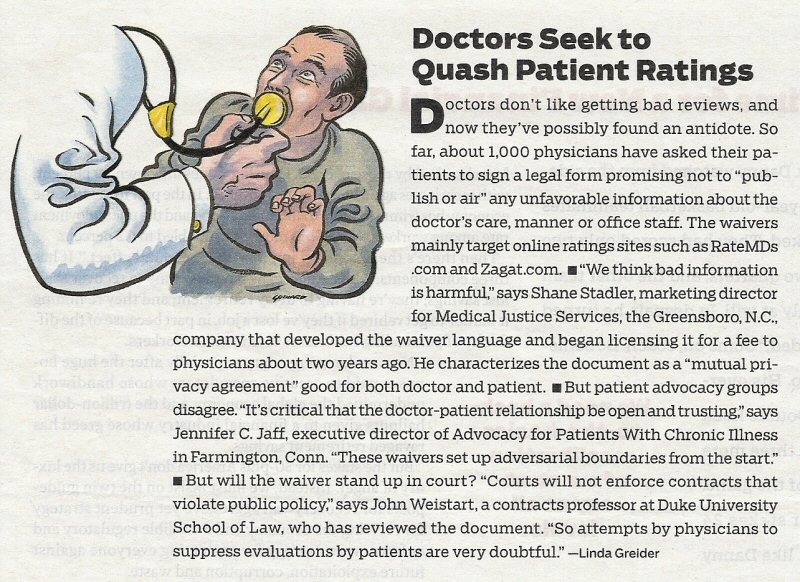
Another reason not to count your chickens...from the May 2009 edition of the AARP Bulletin