|
CAT Tracks for February 27, 2010
SHE HAS SEEN THE LIGHT |
I've read a lot of books during my brief retirement...
Due to my educational background as a Social Studies teacher, I have had occasion over the years to read a lot of non-fiction. During five years of college and 39 years of teaching, well, that's a lot of biographies and history's of this and history's of that.
Probably as a direct result, my new-found freedom to read for pleasure tends toward works of fiction. My favorite authors are Dean Koontz, Jefferey Deaver, and James Patterson (who single-handedly with the able assistance of his stable of collaborators can keep even a retired person busy!)
If you are not familiar with the genre of these authors and their like, let's just say that if a person does not die a particularly horrible death at the hands of a sadistic serial killer within the first chapter...forgetaboutit!
Now, just so you don't get the wrong idea, I'm devoutly on the side of the angels here...rooting for the proper authorities to end the killer's reign of terror (although I am not opposed to the "good guys" exacting gruesome revenge using tactics that might even shock Jack Bauer of 24-fame.)
However, after reading a newspaper article this morning, I shall make an exception. I've got to head out to Barnes & Noble and purchase a book in the non-fiction category...
Diane Ravitch...
As the article below describes, Diane Ravitch is an education historian who served an assistant education secretary under George H.W. Bush and a member of the National Assessment Governing Board in the Clinton and second Bush administrations. Diane Ravitch sat in the East Room of the White House when the second President Bush proposed the No Child Left Behind law in January 2001...and applauded.
NOT my kind of woman!
But, Diane Ravitch has had an obvious change of heart.
In fact, a "one-liner" attributed to her in a 2009 blog has sold me on her book...
Actually, the mental picture evoked by that line for me was our current United States Secretary of Education all decked out in dress and wig...NOT a pretty sight!
I may end up disappointed in Diane's book. I may grow disinterested in her book when someone does not come to an untimely end in the first chapter.
However, I do perceive a common theme with my recent, "normal" reading fare...
Arne Duncan, serial killer...
When you compare their "bodies of work", Arne Duncan is a helluva lot more prolific than Hannibal Lecter ever dreamed of being. You read the news this past week...how (the policies of) Arne Duncan left the lives of 93 people, including 74 teachers, shattered in Central Falls, RI. You saw the picture...a distraught child, head on her former teacher's shoulder, left behind.
THAT alone may keep me reading...the words of a former "disciple", who has seen the light. A person who has walked on the dark side...who is now trying to end the madness, trying to stop the likes of George W. Bush, Rod Paige, Margaret Spellings, Barack Obama, and Arne Duncan.
It is people like Diane Ravitch who have the best chance of ending the senseless reign of terror that has disrupted the lives of so many students and teachers during the past decade and threatens the very existence of public education.
She bears reading...
From The Washington Post
Business principles won't work for school reform, former supporter Ravitch says
By Nick Anderson
For those who believe that performance pay and charter schools pose a threat to public education and that a cult of testing and accountability has hijacked school reform, an unlikely national spokeswoman has emerged.
Diane Ravitch, an education historian, now renounces many of the market-oriented policies she promoted as a former federal education official with close ties to Democrats and Republicans. In large part because of her change of heart, Ravitch's critique of the reform ideas that prevail in government, philanthropies and think tanks is reverberating in the world of education.
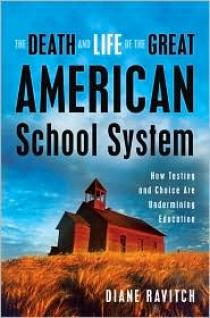
"In choosing his education agenda, President Obama sided with the economists and the corporate-style reformers," Ravitch writes in her book "The Death and Life of the Great American School System," circulating in advance of its general release Tuesday.
She stoutly defends teachers unions, questions the value of standardized test data and calls the president's affinity for independently operated charter schools "puzzling."
"Is Arne Duncan really Margaret Spellings in drag?" Ravitch asked in a February 2009 blog item, suggesting that the education secretary's policies are not much different from those espoused by Spellings, who held the office under President George W. Bush.
Many analysts, educators and policymakers have challenged Ravitch's views. Obama and his education officials say they are collaborating with unions even as they challenge them to rethink the status quo. Still, it is a mark of Ravitch's influence that she landed a meeting with Duncan in his office in October, at his invitation.
"I have great respect for her," Duncan said Thursday. "She's a really smart lady. She cares passionately. We have some differences of opinion."
Duncan said he had heard about Ravitch's book but had not read it.
What gives Ravitch unusual standing is her background.
The New York University scholar, who lives in Brooklyn, was an assistant education secretary under President George H.W. Bush, pushing unsuccessfully for national academic standards, and a member of the National Assessment Governing Board in the Clinton and second Bush administrations, helping to oversee testing policy. She initially backed No Child Left Behind, the law that mandated an expansion of testing and sanctions for schools with poor results.
Chester E. Finn Jr., an education analyst at the Thomas B. Fordham Institute and longtime friend, recalled sitting next to Ravitch in the East Room of the White House when the second President Bush proposed the law in January 2001. "We were both applauding," Finn said. "It seemed to make sense at the time."
In her book, Ravitch writes: "I wanted to believe that choice and accountability would produce great results. But over time, I was persuaded by accumulating evidence that the latest reforms were not likely to live up to their promise. The more I saw, the more I lost the faith."
Ravitch resolved to write the book in 2007 to overcome what she called an "intellectual crisis." Its title echoes the classic 1961 critique of urban planning by Jane Jacobs, "The Death and Life of Great American Cities."
Finn, who held a senior education post in the Reagan administration, said he shares Ravitch's pessimism about the record of education reform. "We agree it's not very encouraging," he said, "and then we come to opposite views of the way forward."
Ravitch, he said, wants to "re-empower" the public school system. "The same evidence has turned me into a radical who wants to blow up the system," he added.
No Child Left Behind is an easy target because it lost political luster years ago. Ravitch also attacks the constellation of forces driving reform today. She says major education philanthropies, including the Bill & Melinda Gates Foundation, rely too much on business principles to improve schools.
Duncan's biggest idea is market-oriented: He seeks to provide incentives for reform, offering billions of dollars to states and school systems willing to take risks to solve problems that have vexed generations of educators. Among his goals are expanding high-quality charter schools, tying teacher evaluation to student achievement data and turning around failing schools -- all in the name of raising graduation rates, he said, to give students a chance to reach their academic and social potential.
Ravitch, who declined to be interviewed for this article, told the trade publication Education Week that she gives Duncan "an A for being effective and a D-minus for bad ideas."
Ravitch urges the adoption of "a substantive national curriculum that declares our intention to educate all children in the full range of liberal arts and sciences, as well as physical education."
That is more expansive than a state-led movement underway for common math and English language arts standards. She also advocates "a short reading list" of up to 10 "indispensable literary classics" for each grade and, in general, more respect for the challenges teachers face in classrooms with students who come from widely divergent social and economic backgrounds.
Susan Ohanian, a blogger, former teacher and opponent of the testing and accountability movement, said she admires Ravitch's shift on No Child Left Behind but disagrees with her about national standards. She follows Ravitch through her Twitter profile, DianeRav.
"Those tweets get passed around everywhere," she said. "I'm always interested in what she has to say. I don't think she's a knee-jerk responder."
Okay, if I harbored any doubts on this "MUST READ", they have vanished!
Remember "my girl", Valerie Strauss, whom I publicly thanked this week in CAT Tracks?
In the margin of the article above, there was a link to "The Answer Sheet by Valerie Strauss". I checked it out...
From The Washington Post
The Answer Sheet
Why you should read Diane Ravitch's new book
Among the many important lessons in Diane Ravitch’s new book, “The Death and Life of the Great American School System,” this one keeps knocking about in my head:
“Reformers imagine that it is easy to create a successful school, but it is not. They imagine that the lessons of a successful school are obvious and can be easily transferred to other schools, just as one might take an industrial process or a new piece of machinery and install it in a new plant without error. But a school is successful for many reasons, including the personalities of its leader and teachers; the social interactions among them; the culture of the school; the students and their families; the way the school implements policies and programs dictated by the district, the state and the federal government; the quality of the school’s curriculum and instruction; the resources of the school and the community; and many other factors. When a school is successful, it is hard to know which factor was most important or if it was a combination of factors.”
Amen. The U.S. public school system would not be as troubled as it is if most of the reformers of the past few decades really understood this. They would have known that charter schools aren’t a silver bullet. Nor are high-stakes standardized tests. Nor is shaming teachers or reducing them to robots who repeat nonsense from bad textbooks.
These notions are not, of course, original to Ravitch. But she has put together a complete, compelling argument, and when she publicly advocates, her words carry far more weight than others.
Why?
If America has a leading education historian, Ravitch, an education professor at New York University, has long had a claim on the title.
For years, she was the darling of conservatives in education. She served as an assistant secretary in the administration of President George H.W. Bush, and was a vocal backer of the second President Bush’s education effort. She was, in fact, at the White House as part of a select group when Bush first outlined No Child Left Behind, and she wrote, she was “excited and optimistic.”
She has written a number of education books that conservatives liked, one of them a scathing critique of leftist historians who attacked the public schools as “an instrument of cultural repression.”
Her credibility with conservatives is exactly why it would be particularly instructive for everyone--whether you have kids in school or not--to read “The Death and Life of the Great American School System.”
Ravitch, who has spent some 40 years in education, explains how she went from supporting No Child Left Behind and its testing and accountability regimes to becoming a vocal critic who thinks the very things she once backed are destroying public schools.
Marshaling a mountain of facts that she reported over years, Ravitch tells through riveting stories and sharp analysis why she no longer believes that public schools should be operated like businesses.
Perhaps she is the one person who can’t be ignored by Education Secretary Arne Duncan and others in the Obama administration who are so far insisting on carrying forward with some of the most insidious aspects of NCLB.
It is an irony that Ravitch’s book has been applauded by Linda Darling-Hammond, a highly respected professor of education at Stanford University and founding executive director of the National Commission for Teaching & America’s Future. Darling-Hammond, who was Obama’s key education advisor during the transition, has long seen the world the way Ravitch views it now.
There had been hope in some corners of the education world that Obama would name her education secretary because of her clear understanding of educational excellence. He didn’t and instead selected Duncan, the former schools chief in Chicago who has become a frequent target of Ravitch’s wrath.
(Darling-Hammond, incidentally, also has written a new book which is a must-read; I’ll talk about it soon.)
Ravitch’s conversion was courageous; it is not often that you see someone in academia, in politics, or, frankly, in any arena, publicly admit they were wrong. Now she finds herself facing the powerful forces that have been arrayed against the kind of reform that she is proposing.
She wants teachers to be paid fairly and not earn “merit pay” based on standardized test results.
She wants public charter schools to stop competing with regular charter schools.
She wants a national curriculum that explains what every child in every grade should be learning.
And she wants people in the worlds of politics and business to stay out of education decisions.
Sounds good to me.
"Is Arne Duncan really Margaret Spellings in drag?"
Washington Post Staff Writer
By Valerie Strauss