|
CAT Tracks for April 28, 2010
TEACHING FOR DUMMIES |
Jay Mathews is so full of it...
...sitting atop his mountain of collected wisdom, floating in the midst of the hot air he generates daily, bombastically intoning the evils he perceives, leading us to his own personalized, educational promised land.
DAMN...I need to paws. Did I just borrow that last paragraph from Jay? Were those comments by him...about me? Oops, silly me. I forgot...Jay doesn't know about me! CAT Tracks didn't make "the list" of top educational blogs for 2010. Another of those Emily Litella moments..."Never Mind!"
Back to Jay...
Hey, I don't even disagree with Jay today!
Let me clarify that...
I don't disagree with Jay's assessment of Schools of Education or the sage wisdom of the revered educational philosophers. As an SIU "teacher in training" back in the 1960s, I was certainly no fan of Bloom, Dewey, or Blooming Dewey...a waste of my valuable time, time preferably spent on card-playing. (No video games for dinosaurs. Sigh...)
However, for Jay to make his pronouncement...
This new cohort is frustrated with traditional teacher training. They think most education schools are too fond of theory (favorite ed school philosopher John Dewey died in 1952 before many of their parents were born) and too casual about preparing them for the practical challenges of teaching impoverished children."
Jay, Jay, Jay...
I never taught in a real "urban public school", but I would pontificate that I experienced the same woes (on an albeit smaller scale) during my 39 years in a classroom in a dying town located in Southern Illinois. (Teachers in Cairo School District Number One are suffering those same trials and tribulations...TODAY...as I type!)
Jay...
What gives you the right to assert that "our urban public schools have many teachers in their twenties and thirties who are more impatient with low standards and more determined to raise student achievement than previous generations of inner city educators"? (Oh, that's right...it IS your blog! "Never Mind!")
But, Jay...that is just sooooooooooooo much BS!
"Every generation blames the one that came before, and all of their frustrations come beating on your door..." (So sang Mike & The Mechanics in "The Living Years".)
Surely, Jay...you are NOT saying that the youth of the 1960s (including the youth that entered the classrooms in the 1960s) were not radical in their thinking? If so, then one of us needs to go back and roll the video tape...
And, Jay...
We found our own "how to" book. Since you are into page counting, let it be known that our book was only 190 pages...NOT the 332 pages of your tome! No "49 Techniques", only seven, short, easy-to-read chapters.
Without further ado...
"...Our urban public schools have many teachers in their twenties and thirties who are more impatient with low standards and more determined to raise student achievement than previous generations of inner city educators, having seen some good examples. But they don’t know what exactly to do.
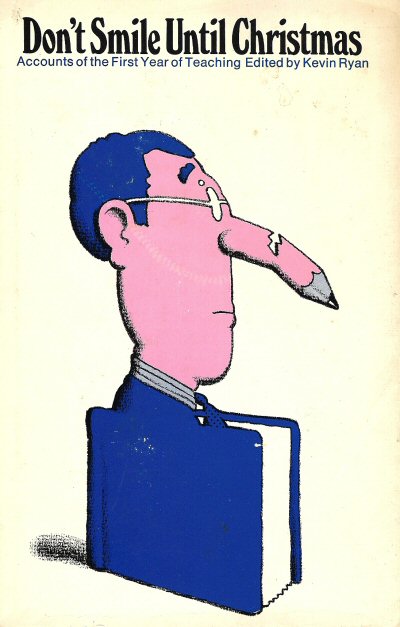
Conveniently, the book was published in 1970...during my first "floundering" year of teaching. I was the "newbie", filled to the ears with educational philosohy...philosophy that failed miserably when applied to the reality "in the trenches".
Oh, I'm sure the book won't pass your muster, Jay. One glance at the cover, and you'd probably just grumble that the book was visual PROOF of what's wrong with education today...a bible written for "uncaring" dinosaurs, promoting their kind and their practices.
In rebuke, I offer a couple of pages from the introduction...
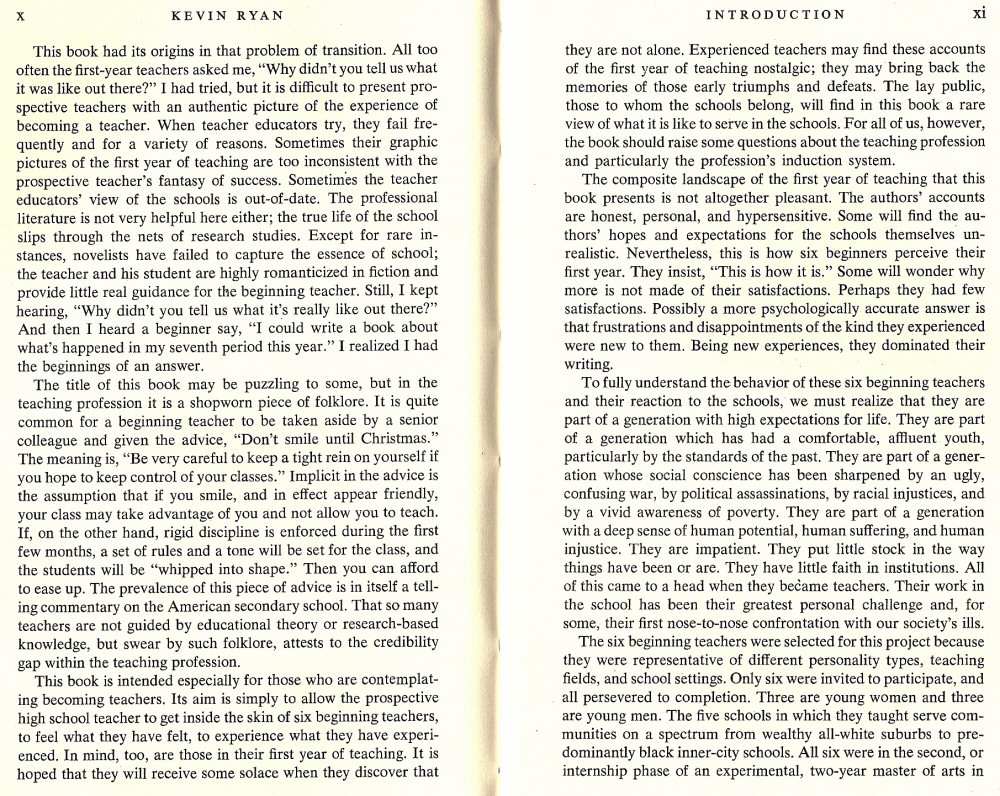
Uncaring dinosaurs?
I think not, Jay...
Just in case you missed it, be sure to read the second page, second full paragraph. The author even uses your words, Jay..."They are impatient."
It is who we were, Jay...it is who we remain.
It's just that after a life-long career of living and learning and, yes, teaching...we have reached or are approaching the end of our professional careers.
A simple "Thank You" and a little respect would have been nice...
From The Washington Post...
Class Struggle
By Jay Mathews
Explosive book for a new teacher generation
A storm is brewing in teacher training in America. It involves a generational change that we education writers don’t deal with much, but is more important than No Child Left Behind or the Race to the Top grants or other stuff we devote space to. Our urban public schools have many teachers in their twenties and thirties who are more impatient with low standards and more determined to raise student achievement than previous generations of inner city educators, having seen some good examples. But they don’t know what exactly to do.
This new cohort is frustrated with traditional teacher training. They think most education schools are too fond of theory (favorite ed school philosopher John Dewey died in 1952 before many of their parents were born) and too casual about preparing them for the practical challenges of teaching impoverished children.
So they are welcoming a new book. Much-underlined versions of it have been passed around like samizdat literature. Its title, “Teach Like A Champion: 49 Techniques That Put Students on the Path to College,” sounds phony. But the origins of this 332-page paperback, plus DVD, suggest education schools, and local teacher evaluation systems like those in D.C. and Montgomery County, are going to have to deal with it or wish they had.
The author, Doug Lemov, 42, is a managing director of Uncommon Schools, one of the high-performing public charter schools networks leading the charge against school district bureaucracies and old ways of training. He has watched and videoed the moves made and the words spoken by the most successful classroom teachers he knows, then written down the techniques they share.
There is much detail. I was exhausted just reading it. First of the 49 techniques is “No Opt Out,” what you do when a student says she can’t answer your question or doesn’t respond at all. You move to other students, and when you get the right answer return to the first student and insist she repeat what she just heard, proving no one can excuse themselves from your class. Number 38 is “Strong Voice,” speaking clearly and forcefully while standing still in a way that makes it difficult for students NOT to hear what you are saying. Number 49 is “Normalizing Error,” responding to a wrong answer with a quick and non-judgmental effort to get the right one, so students realize that making mistakes is just part of the learning process.
For an technical book aimed at teachers, “Teach Like a Champion” is getting big play, including a March 7 cover story in the New York Times Magazine by GothamSchools.org editor Elizabeth Green. Whether that will produce big results is not so clear.
Many education schools are taking steps in this direction, particularly with video. But Lemov provides more detail than many of them are comfortable with. One professor told me education students can’t be motivated to embrace such methods until they are in a rough classroom fighting to survive. The ed schools give them theory and practice in digestible form, and send them off. If they don’t get a good mentor teacher, they are in trouble.
Teachers creating new evaluation systems in D.C. and Montgomery share some of Lemov’s impatience. What he is offering is hard, and easy to dismiss it as too minimal, too routinized, too basic. Whether it succeeds depends on how many of the restless new generation of teachers are willing to work that hard, when some experts say they don’t need it and the pay isn’t that good anyway. But as Lemov puts it, methods that work as well as these make the school day go much more quickly and smoothly, and justify the high hopes of this new group of educators.