 |
CAT Tracks for October 3, 2011
HIGH ROAD...LOW ROAD |
Two articles in the New York Times this morning on reaching out to minorities and the poor...
Me?
Since I assigned the labels, it will come as no surprise.
I'll take "Mr. Williams" any day of the week over "Joe the Teacher".
From the New York Times...
A State Grooms Its Best Students to Be Good Teachers
By MICHAEL WINERIP
John Williams III in science class on Thursday. He came to the profession
DURHAM, N.C. — When Mr. Williams means business, he is not kidding around. “He’s pretty quiet, pretty serious,” said Ashabur Rahman, a fifth grader at Glenn Elementary School who has him for math and science.
John Williams III, 36, is not some jokey teacher. “At the start of the year, some kids said he was going to be the meanest teacher in the school,” said Trajen Womack. Chelsea Parra, heard the same: “A lot of people were saying it.”
Nor is he easy about giving out 1’s, the top grade. “If we’re joking, he doesn’t say anything, but on the progress report, he’ll give you a 3,” Trajen said.
Still, the more time they spent with Mr. Williams, the smarter he seemed to get. In science, they made terrariums, growing rye, mustard and alfalfa. There is no running water in the trailer behind the school where Mr. Williams teaches, so he carries it in, using jugs. This week, the students will add crickets and rolly-pollies to their ecosystems.
He always calls them ladies and gentlemen, and speaks so softly that they must be quiet to hear him; even a little noise sounds loud in Mr. Williams’s room.
Last week, during a lesson on common denominators, a new boy began tapping on his desk. Mr. Williams ignored it and kept teaching. The boy sat on the floor, twirled a ruler and wandered around talking to other students. Mr. Williams kept teaching. When the boy could no longer be ignored — he knocked over a chair — Mr. Williams made eye contact with a special education teacher, who took over the class. Mr. Williams went and sat by the boy.
In a voice so quiet that Citlaly Reynoso, who was sitting next to them, could not hear, he talked to the boy for several minutes. Then Mr. Williams took over the class again, and the boy pulled out a workbook and started answering questions.
Later Mr. Williams, who has spent 14 years teaching poor children, said: “I want to do everything I can to keep that child in class. If he’s sitting in the principal’s office, he’s not learning.”
In 1993, when Mr. Williams graduated from high school in Goldsboro, N.C., with an A average and a 1,320 on his SATs, he had many options, but he chose the North Carolina Teaching Fellows Program. The idea is simple: the state pays top academic students to attend a public college, and in return they spend at least four years teaching in a public school.
In the 20 years since the first fellows began teaching, the program has flourished. High school seniors selected for the program average about 1,200 on the SATs compared with a state average of 1,000. Of the 500 fellows chosen each year, about a quarter are black or Hispanic.
Mr. Williams said that once he was accepted, colleges competed for him. “They woo you like an athlete,” he said. “We got the star treatment.”
It is not enough for the smartest to become teachers; they have to stay teaching. Research has shown that experienced teachers perform far better than beginners. A Carolina Institute for Public Policy study by Gary T. Henry, Charles Thompson and Kevin Bastian in 2010 found that of a dozen training programs in the state, Teach for America had the best test results, with the Teaching Fellows Program second.
There is, however, a large difference in retention. Teach for American requires only a two-year commitment. After five years, 7 percent of the Teach for America participants were still at work in North Carolina, versus 73 percent of the fellows. Sixty percent of the fellows who started teaching 20 years ago still work in North Carolina public schools.
Representative David E. Price, Democrat of North Carolina, tried for years to get Congress to pass legislation using the Teaching Fellows Program as a national model, and finally succeeded a few years ago. But financing has been limited. New York, one of 12 states that won a grant, received enough money to prepare only 125 teachers over five years.
It is a pretty good bet that any program that treats teachers like star athletes is not going to last. A few months ago, as part of hundreds of millions of dollars in cuts, the North Carolina General Assembly voted to phase out the fellows program — which has a $13 million annual budget — over the next few years. (There have been reports that the House speaker, Thom Tillis, a Republican, is reconsidering; his office did not respond to several calls and e-mails.)
It may not matter. Budget cuts have been so severe, pretty soon no one is going to be able to afford to teach. Anthony White, 26, another fellow, has been a math teacher for five years at Southern High School here. Like Mr. Williams, he had his choice of jobs but chose a school that serves a poor black neighborhood, a place where he felt that his work would stand for more. “Coming up,” Mr. White said, “I never had a black male math teacher.”
When Mr. White started, he was making $35,000, and five years later he is still making $35,000.
It has been said before: no one goes into teaching for the money, and any glory is mighty modest.
Last spring, when Mr. Williams was named Teacher of the Week by WRAL-TV in the Raleigh-Durham area, the reporter referred to him as “a humble John Williams.”
Most of the great things that teachers do are not seen by adults, and are taken for granted by children.
The new boy in Mr. Williams’s class closed the workbook after a few minutes and put his head on the desk. A guidance counselor had warned Mr. Williams to be on guard; the boy’s father had died the week before. When everyone filed out for recess, Mr. Williams held him back and spoke to him gently. The boy kept his back to him the entire time. When Mr. Williams told him to go play, the boy walked away backward, stopping at the bottom of a grassy hill that leads to the playground.
Mr. Williams moved up the hill a little and the boy followed, then stopped. Mr. Williams walked up a little more, the boy followed and stopped. From a distance, it looked like Mr. Williams was tugging him up the hill with an invisible rope.
Dressed in a bow tie, stylish shirt and creased pants, Mr. Williams looked thoroughly out of place on that hill. With one final tug, he got the boy to the top. For a while, the boy stood with his back to everyone, then for no apparent reason he ran off, disappearing into the crowd of excited, noisy children.
Mr. Williams made his way back down the hill slowly, so as not to trip. When he got to the bottom, he said, “Hopefully, he’s out there enjoying himself.”
From the New York Times...
Incentives for Advanced Work Let Pupils and Teachers Cash In
By SAM DILLON
When 43 of Joe Nystrom's students passed an Advanced Placement test,
WORCESTER, Mass. — Joe Nystrom, who teaches math at a low-income high school here, used to think that only a tiny group of students — the “smart kids” — were capable of advanced coursework.
But two years ago, spurred by a national program that offered cash incentives and other support for students and teachers, Mr. Nystrom’s school, South High Community School, adopted a come one, come all policy for Advanced Placement courses. Today Mr. Nystrom teaches A.P. statistics to eight times as many students as he used to, and this year 70 percent of them scored high enough to qualify for college credit, compared with 50 percent before. One in four earned the top score possible, far outpacing their counterparts worldwide.
South High students said Mr. Nystrom and his colleagues had transformed the culture of a tough urban school, making it cool for boys with low-slung jeans who idolize rappers like Lil Wayne to take the hardest classes.
They were helped by the National Math and Science Initiative, a nonprofit network that provided laboratory equipment and special training for teachers and organized afternoon tutoring and Saturday sessions. It also paid $100 each to students who scored a 3 or above on the A.P. exam — and to their teachers, who can also earn additional rewards. Because 43 of his students passed the exam this year, far above his target, Mr. Nystrom will add a $7,300 check to his $72,000 salary.
Organizers of the initiative, who met with lawmakers and staff members at a Congressional briefing last month, said that over three years, the program led to nearly 38,000 A.P. exams being taken in math, science and English, many of them by black and Hispanic students. This year, 308 schools in six states are participating.
The initiative’s success is refueling a debate over whether cash bonuses can coax improved performance from teachers and students — a New York City incentive program was disbanded — and whether paying students for schoolwork diminishes their ability to feel intrinsic pleasure in achievement for its own sake.
Roland G. Fryer, a Harvard economist who won a MacArthur Foundation award last month for his research on educational incentives, said that cash alone did not consistently raise achievement, but that combining payments with tutoring, teacher training and other tactics could be promising.
Of the 1,853 teachers participating in the initiative last year, more than half earned bonuses of at least $2,000, said Gregg Fleisher, a director of the initiative. Brian Leonard, who teaches A.P. calculus and statistics at Lake Hamilton High School in Arkansas, earned the largest award, $12,500, because 65 of his students passed the exams.
Three years ago, Lake Hamilton High had nine A.P. math students, and their parents were all doctors, lawyers or other professionals, Mr. Leonard said.
“I had a boy last year who was your quintessential average rural student: always dressed in camo, his dad was a mechanic,” he said. “He signed up for A.P. statistics, I worked with him, and he came out passing the exam.”
The College Board, which administers the A.P. program, has endorsed the math and science initiative, which is based in Dallas and is financed largely by Exxon.
In a book published last year, “AP: A Critical Examination of the Advanced Placement Program,” some academics expressed concern that under a push by the College Board to broaden its reach, too many unprepared students were taking — and failing — A.P. classes.
But Philip Sadler, a Harvard lecturer who edited the book, said of the effort: “They’re doing the right things and have had substantial increases in the number of kids who pass some A.P. exam. So that’s all good news.”
South High Community, which sits on a hilltop in this gritty town west of Boston, acquired a violent reputation after a Hispanic student stabbed a black classmate to death in 1989. Eighty-five percent of its 1,220 students this year were poor enough to qualify for the federal lunch program. Like many schools, South had previously let students take A.P. classes only they if had passed certain prerequisite courses with high grades and obtained a teacher’s recommendation.
In 2009, the school began working with the math and science initiative, which requires that all barriers to A.P. enrollment be removed. “My initial instinct was that if we let everybody in, it was just going to dumb down the classes,” Mr. Nystrom recalled.
But the school began urging students during announcements to sign up for A.P. classes, making it clear in guidance sessions and in meetings with parents that they were not just for white or middle-class students.
Mr. Nystrom had his own recruitment program. He made tongue-in-cheek posters portraying the rap stars Lil Wayne and Flavor Flav, as well as the male heartthrobs in “Twilight,” endorsing A.P. statistics as the supposed keys to success in life.
Forty-six students enrolled in Mr. Nystrom’s class in 2009, up from 12 the year before, of whom six had earned qualifying scores of at least 3 out of 5. Of the 46 students, 22 earned qualifying scores on exams in May 2010.
Last fall, enrollment surged to 61 students. Forty-three of those passed the exam, and 15, or 25 percent, got the top score. Worldwide, 15 percent of the 18,000 people who took the statistics exam got 5’s this year.
Thirty-one low-income students from Mr. Nystrom’s class passed the exam, more than at any other high school in Massachusetts.
The teacher’s manic energy and persistence may be one reason for his success. In his first-period class the other day, Mr. Nystrom outlined the meaning of basic vocabulary words in statistics — sample, parameter, inference — and then went over nuances.
Using an overhead projector, he drew a contingency table relating the relative preferences of males and females for hip hop, country and indie rock music, then used the table to explain marginal distribution.
Some students struggled to understand the table, and he explained it again — until Ashley Tran, a 15-year-old sophomore, interrupted.
“Oh, I get it!” she exclaimed.
“My favorite sound!” Mr. Nystrom said. Kristopher Santana, 17, a senior whose mother is a customer service representative at a tool company, was among those who scored a 5 in May. He said the 18 hours of Saturday classes organized by the initiative, and Mr. Nystrom’s twice-weekly, after-school tutoring sessions, had been helpful.
And the $100 incentive?
“There’s something cool about the money,” Kristopher said. “It’s a great extra.”
Mr. Nystrom attributed his students’ success to the Saturday classes, the extra training he got and the collective effort by his colleagues to persuade students that hard work can bring success.
“I’d like to think the incentive payments had little impact,” he added. “But maybe way in the back of my mind, I know that if I just push a little harder and work every minute of every class, more students might pass the exam, and I might increase my monetary incentive.”
Take your pick...
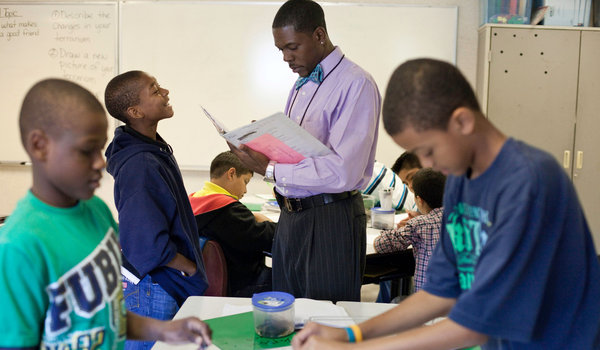
through the North Carolina Teaching Fellows Program.
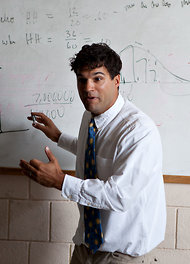
they got $100.


